Inversion Turns Lines Into Circles
One of the most disorienting transformations in geometry is inversion. A point at distance $r$ from the origin is sent to the same direction but distance $1/r$. Nearby points far from the origin get squeezed inward. Nearby points close to the origin fly outward.
In complex notation, inversion with reflection is the map
Ignoring the reflection detail for a moment, the essential move is reciprocal distance. The origin is not sent anywhere finite, and infinity behaves like a missing point that wants to become the origin.
This sounds like it should mangle straight objects beyond recognition. Surprisingly, it sends many straight lines to perfect circles.
live slideshowessay-2026-inversion-turns-lines-into-circles-1.mcs
param offset = 0.8
background = BLACK
camera = Camera(4b)
let Diagram = |offset| block {
let radius = 1 / (2 * offset)
. stroke{GRAY, 1} Line(start: [-3, 0, 0], end: [3, 0, 0])
. stroke{GRAY, 1} Line(start: [0, -1.8, 0], end: [0, 1.8, 0])
. fill{WHITE} center{[0, 0, 0]} Circle(0.035)
. stroke{ORANGE, 3} Line(start: [-3, offset, 0], end: [3, offset, 0])
. stroke{BLUE, 3} center{[0, radius, 0]} Circle(radius)
. stroke{GREEN, 1.4} center{[0, radius, 0]} Circle(radius)
. color{WHITE} center{[0, -1.55, 0]} Text("line inverts to circle", 1.00)
}
mesh diagram = Diagram($offset)
"move the line"
offset = 1.25
play Lerp(1.2)
"bring it closer"
offset = 0.52
play Lerp(1.2)The orange line is $y=a$. The blue curve is the inversion of that line. The green circle is not a visual approximation. It is exactly the image circle.
The algebra is short
Take a point $(x,a)$ on the line $y=a$, where $a>0$. Under inversion in the unit circle, it moves to
We claim that $(X,Y)$ lies on the circle centered at $(0,\frac{1}{2a})$ with radius $\frac{1}{2a}$. To check, compute
Substitute the formulas:
The second term has numerator $a^2-x^2$ after putting it over the denominator $2a(x^2+a^2)$, so the whole expression becomes
That is exactly the square of the claimed radius.
Why the circle touches the origin
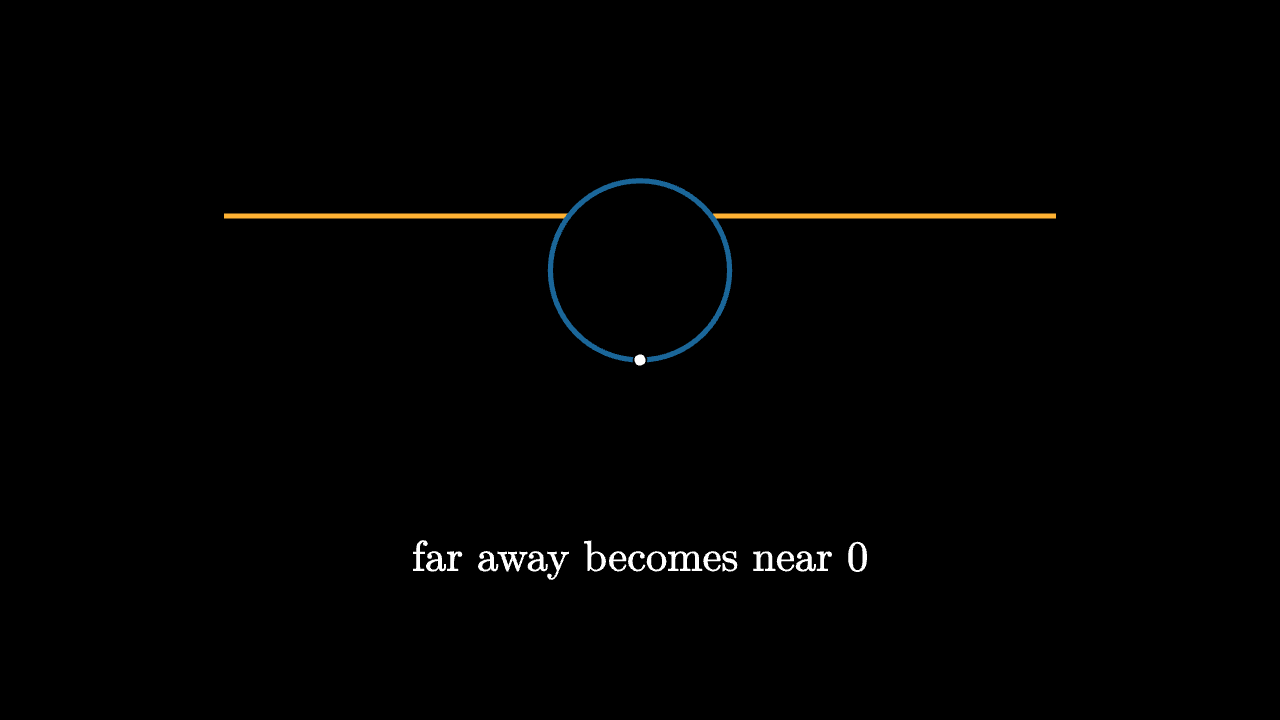
As $x$ goes to infinity along the original line, the inverted point tends to $(0,0)$. The ends of the line do not disappear independently; both ends approach the same missing point at the origin. That is why the image is a circle tangent to the origin.
imageessay-2026-inversion-turns-lines-into-circles-2.mcs
background = BLACK
camera = Camera(4b)
mesh summary = block {
. stroke{ORANGE, 3} Line(start: [-2.6, 0.9, 0], end: [2.6, 0.9, 0])
. stroke{BLUE, 3} center{[0, 0.56, 0]} Circle(0.56)
. fill{WHITE} center{[0, 0, 0]} Circle(0.04)
. color{WHITE} center{[0, -1.25, 0]} Text("far away becomes near 0", 0.96)
}
"line to tangent circle"
play Fade(0.6)There is a broader theorem hiding here: generalized circles, meaning ordinary circles and lines, are preserved by Mobius transformations. Lines are included because a line is a circle through the point at infinity. Once infinity is treated as a legitimate point on the Riemann sphere, the rule becomes cleaner:
The animation is a flat shadow of that spherical fact. Inversion feels singular in the plane because the plane has removed one point from the sphere. Put the missing point back, and the transformation becomes a smooth symmetry of the whole extended complex plane.