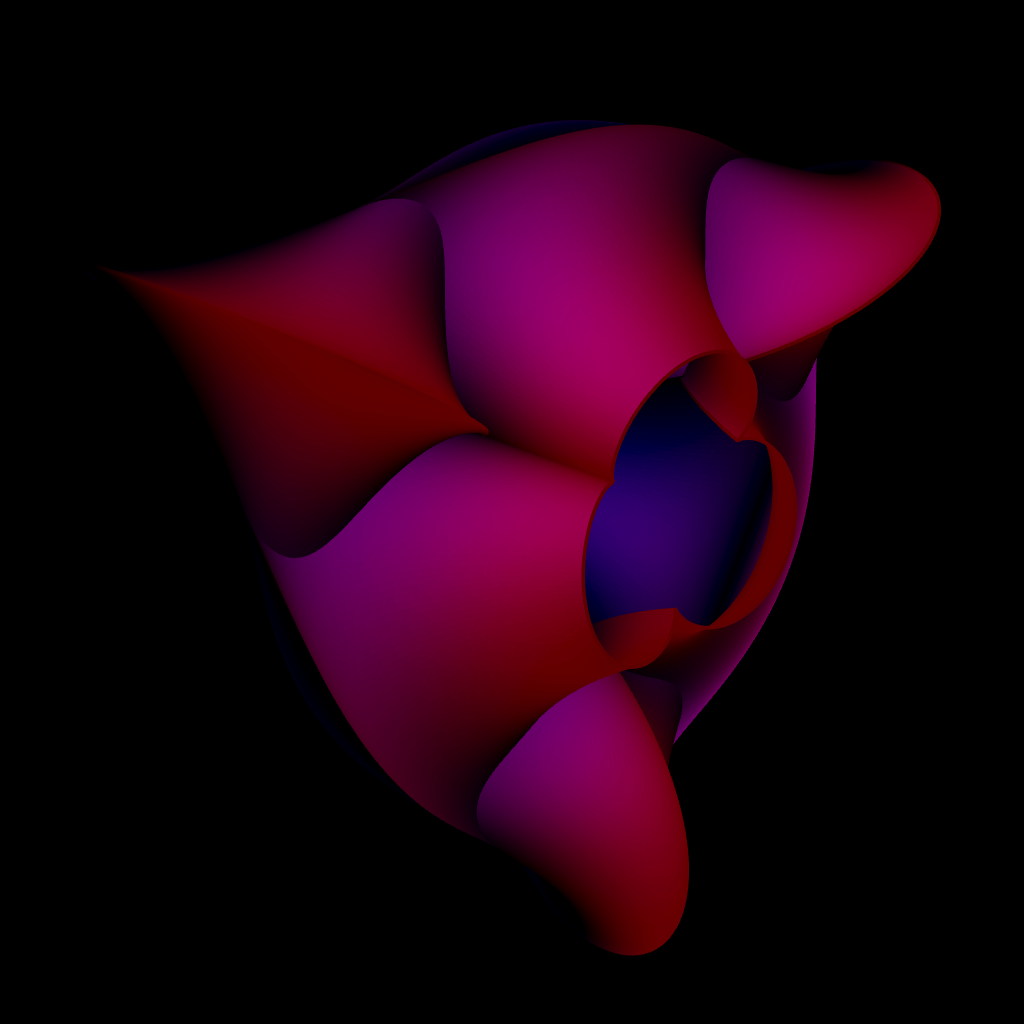
Conformal Maps Keep Tiny Angles
A function from the plane to itself can do many things. It can fold space, stretch one direction more than another, or collapse a whole region to a line. Complex differentiable functions are far more constrained. Away from points where the derivative vanishes, they look locally like a rotation and a uniform scaling.
That is what "conformal" means: tiny angles are preserved.
The simplest nonlinear example is
It doubles arguments and squares radii. A ray at angle $\theta$ goes to a ray at angle $2\theta$. A circle of radius $r$ goes to a circle of radius $r^2$. Globally, the map wraps the plane around itself. Locally, away from the origin, it still preserves angles.
live slideshowessay-2026-conformal-maps-keep-tiny-angles-1.mcs
param angle = 0.65
background = BLACK
camera = Camera(4b)
let square = |r, t| [r * r * cos(2 * t), r * r * sin(2 * t), 0]
let RayImage = |t| block {
. stroke{BLUE, 3} Line(start: square(0.2, t), end: square(1.2, t))
}
let Diagram = |angle| block {
. stroke{GRAY, 1} center{[0, 0, 0]} Circle(0.45)
. stroke{GRAY, 1} center{[0, 0, 0]} Circle(1.0)
. RayImage(0)
. RayImage(angle)
. stroke{ORANGE, 3} Line(start: [0, 0, 0], end: [1.6, 0, 0])
. stroke{ORANGE, 3} Line(start: [0, 0, 0], end: [1.6 * cos(angle), 1.6 * sin(angle), 0])
. color{WHITE} center{[0, -1.65, 0]} Text("z^2 doubles angles globally", 0.84)
}
mesh diagram = Diagram($angle)
"change the angle"
angle = 1.1
play Lerp(1.4)The global angle between the two rays is doubled. So how can this map preserve angles? The answer is that conformality is local. It does not promise that large shapes keep their angles as seen from the origin. It promises that if two curves cross at a point, then their images cross at the same angle at the image point.
The derivative as a tiny multiplier
For a complex function $f$, differentiability means that near a point $z_0$,
The number $f'(z_0)$ is complex. Multiplication by a complex number has a simple geometry: rotate by its argument and scale by its magnitude.
So if $f'(z_0)\ne 0$, every tiny displacement $h$ near $z_0$ is transformed by the same rotation and the same scale. That preserves the angle between any two tiny displacements.
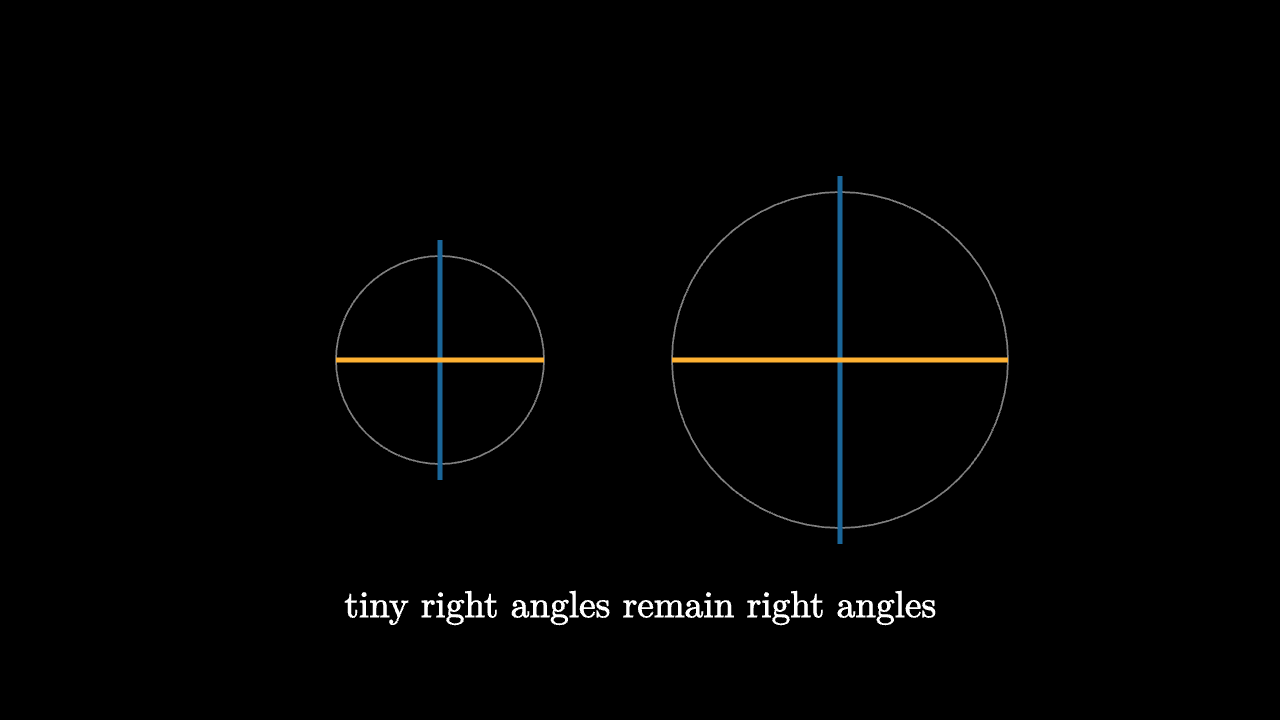
This is much more restrictive than a general real two-dimensional derivative. A general linear map can stretch more in one direction than another, turning circles into ellipses. A nonzero complex derivative turns tiny circles into tiny circles.
Why the origin is special for $z^2$
For $f(z)=z^2$,
Away from $0$, the derivative is nonzero, so the map is conformal. At $0$, the derivative vanishes. There, the local picture degenerates. Tiny displacements are no longer scaled by a nonzero multiplier; first-order information disappears, and the second-order behavior takes over.
That is why the origin is where the angle-doubling nature of $z^2$ is visible. It is a branch point, a place where the local one-to-one structure breaks.
imageessay-2026-conformal-maps-keep-tiny-angles-2.mcs
background = BLACK
camera = Camera(4b)
mesh diagram = block {
. stroke{GRAY, 1} center{[-1.25, 0, 0]} Circle(0.65)
. stroke{GRAY, 1} center{[1.25, 0, 0]} Circle(1.05)
. stroke{BLUE, 3} Line(start: [-1.25, -0.75, 0], end: [-1.25, 0.75, 0])
. stroke{ORANGE, 3} Line(start: [-1.9, 0, 0], end: [-0.6, 0, 0])
. stroke{BLUE, 3} Line(start: [1.25, -1.15, 0], end: [1.25, 1.15, 0])
. stroke{ORANGE, 3} Line(start: [0.2, 0, 0], end: [2.3, 0, 0])
. color{WHITE} center{[0, -1.55, 0]} Text("tiny right angles remain right angles", 0.84)
}
"local angle"
play Fade(0.6)Maps as coordinate systems
Conformal maps are powerful because they let you change coordinates without damaging angles. In physics, this matters for fluid flow and electrostatics. In geometry, it means complicated regions can sometimes be replaced by simpler ones while preserving the local angular structure.
The cost is that lengths are not preserved. A conformal map may stretch different parts of the plane by different amounts. What it preserves is the shape of infinitesimal figures up to scale.
That phrase "up to scale" is the whole point. A tiny square might become a larger or smaller square, rotated. It does not become a tiny rectangle unless the derivative vanishes or conformality fails.
Complex differentiability is therefore not just real differentiability with an extra letter. It is a local symmetry constraint. It says every sufficiently small observer sees the same kind of world after the map: rotated, resized, but not sheared.