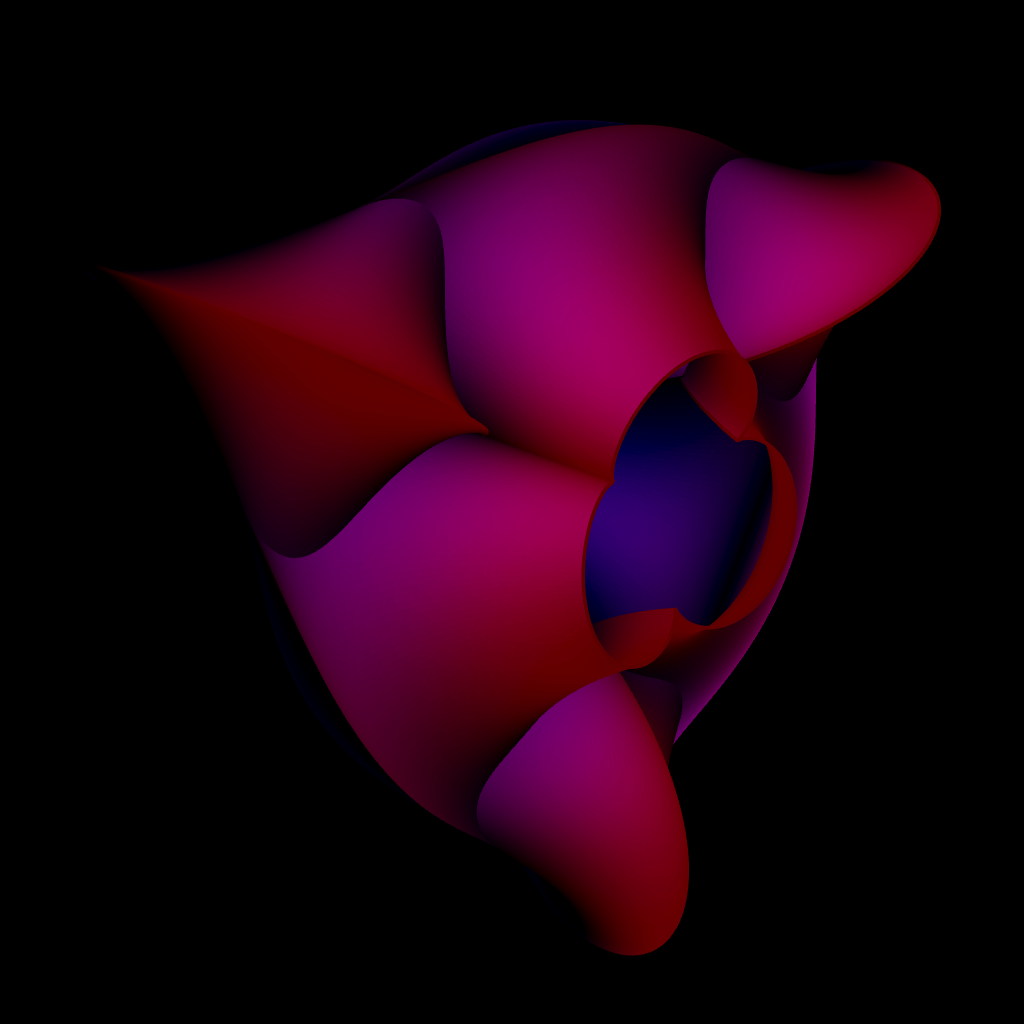
Gauss Bonnet Counts Turning
Some theorems feel like coincidences until you see the accounting behind them. The Gauss-Bonnet theorem is one of these. It says that curvature, which looks local, is tied to topology, which is global.
For a compact surface without boundary, the theorem says
where $K$ is Gaussian curvature and $\chi(M)$ is the Euler characteristic.
For a sphere, $\chi=2$, so the total curvature is $4\pi$. For a torus, $\chi=0$, so positive and negative curvature cancel. The theorem is not saying every sphere has the same shape. It says every sphere has the same total curvature budget.
Before surfaces, there is a planar version that is easier to feel.
A closed curve turns once
Walk around a smooth simple closed curve in the plane. Carry a tangent arrow. By the time you return to the start, the arrow has rotated exactly one full turn.
So the total signed curvature is
This is true for a circle, but it is not special to circles. A wobbly oval may turn quickly in some places and slowly in others, but the total turn is still one revolution.
live slideshowessay-2026-gauss-bonnet-counts-turning-1.mcs
param wobble = 0.0
background = BLACK
camera = Camera(4b)
let UpperCurve = |wobble| block {
. stroke{BLUE, 3} ExplicitFunc(|x| sqrt(1 - x * x / 4) + wobble * sin(3 * x), [-2, 2, 160])
}
let LowerCurve = |wobble| block {
. stroke{BLUE, 3} ExplicitFunc(|x| -sqrt(1 - x * x / 4) + wobble * sin(3 * x), [-2, 2, 160])
}
let Diagram = |wobble| block {
. UpperCurve(wobble)
. LowerCurve(wobble)
. color{WHITE} center{[0, -1.65, 0]} Text("closed plane curves turn once", 0.88)
}
mesh diagram = Diagram($wobble)
"bend the curve"
wobble = 0.5
play Lerp(1.4)The curve changes, but the accounting does not. Local curvature can move around, concentrate, and spread out. The total turning number is topological as long as the curve stays simple and closed.
Gauss-Bonnet is the surface version of this idea.
Curvature as angular defect
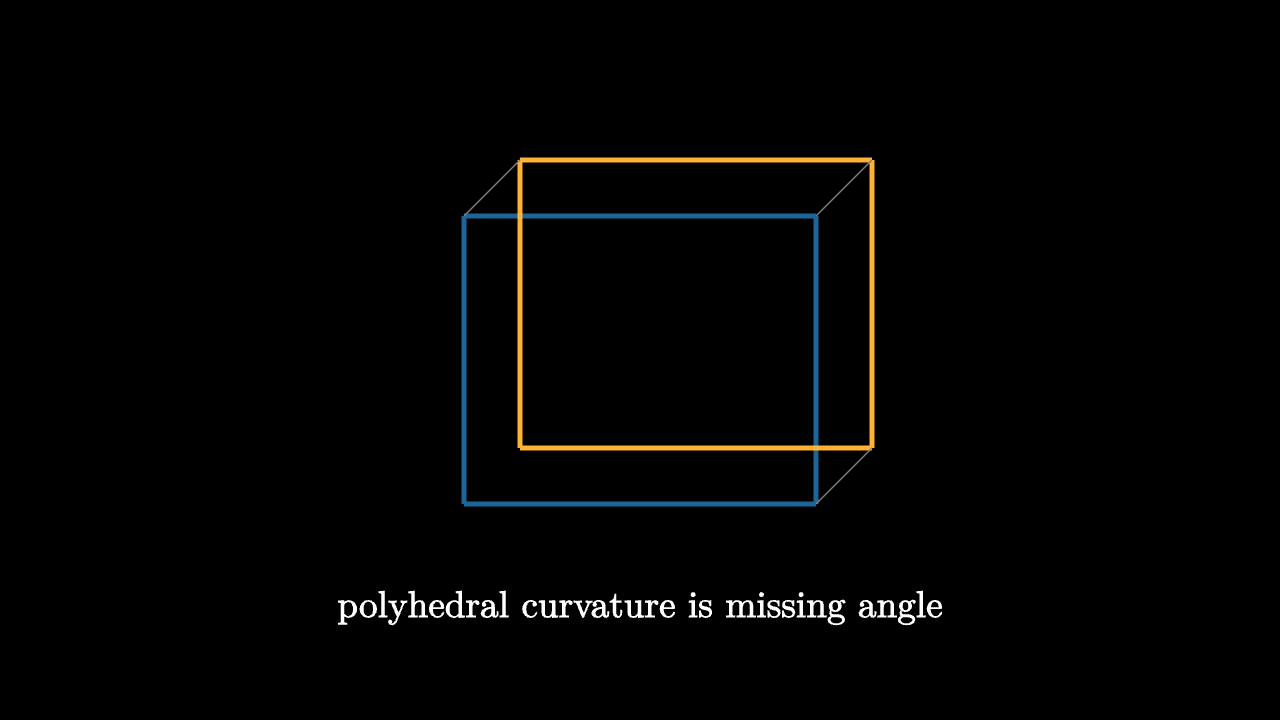
For polyhedra, curvature becomes especially tangible. At a flat point, angles around the point add to $2\pi$. At the vertex of a cube, three right angles meet, adding to $3\pi/2$. The missing angle
is curvature concentrated at that vertex.
A cube has eight vertices, each with defect $\pi/2$, so the total defect is
The cube has the same total curvature as a sphere. Not because it is round, but because it has the same topology.
imageessay-2026-gauss-bonnet-counts-turning-2.mcs
background = BLACK
camera = Camera(4b)
mesh diagram = block {
. stroke{BLUE, 3} Line(start: [-1.1, -0.9, 0], end: [1.1, -0.9, 0])
. stroke{BLUE, 3} Line(start: [1.1, -0.9, 0], end: [1.1, 0.9, 0])
. stroke{BLUE, 3} Line(start: [1.1, 0.9, 0], end: [-1.1, 0.9, 0])
. stroke{BLUE, 3} Line(start: [-1.1, 0.9, 0], end: [-1.1, -0.9, 0])
. stroke{ORANGE, 3} Line(start: [-0.75, -0.55, 0], end: [1.45, -0.55, 0])
. stroke{ORANGE, 3} Line(start: [1.45, -0.55, 0], end: [1.45, 1.25, 0])
. stroke{ORANGE, 3} Line(start: [1.45, 1.25, 0], end: [-0.75, 1.25, 0])
. stroke{ORANGE, 3} Line(start: [-0.75, 1.25, 0], end: [-0.75, -0.55, 0])
. stroke{GRAY, 1} Line(start: [-1.1, 0.9, 0], end: [-0.75, 1.25, 0])
. stroke{GRAY, 1} Line(start: [1.1, 0.9, 0], end: [1.45, 1.25, 0])
. stroke{GRAY, 1} Line(start: [1.1, -0.9, 0], end: [1.45, -0.55, 0])
. color{WHITE} center{[0, -1.55, 0]} Text("polyhedral curvature is missing angle", 0.84)
}
"angle defect"
play Fade(0.6)Why topology appears
Euler's formula for a convex polyhedron is
If you add up the angular defects over all vertices, the face angles, edge incidences, and vertex counts conspire to produce
That is the discrete Gauss-Bonnet theorem for a sphere-like polyhedron. The expression $V-E+F$ is topological. You can bend faces, subdivide edges, or change the shape, but as long as the surface remains sphere-like, the total defect stays $4\pi$.
Smooth Gauss-Bonnet is what happens when curvature is spread continuously instead of concentrated at vertices.
Local freedom, global constraint
A surface can move curvature around. A sphere can be stretched into an ellipsoid. Positive curvature may concentrate near some regions and weaken in others. But the integral of curvature cannot change unless the topology changes.
This is a profound kind of conservation law. It says local geometry has a global budget.
The theorem also explains why flat maps of the Earth must distort something. A sphere has total curvature $4\pi$; a flat plane has curvature $0$. You cannot flatten a sphere without tearing, overlapping, or distorting distances and areas. The curvature budget does not fit.
Gauss-Bonnet is therefore not just a formula. It is a warning: local measurements may be flexible, but their total can remember the shape of the whole world.