Precalculus
Functions, exponentials, logarithms, complex numbers and series.
These are the functions calculus will be done on. The series opens with how a formula moves its graph, builds exponentials and the number e from compound growth, and inverts them to get logarithms. Complex numbers and Euler's formula connect exponentials to rotation, and the final lessons cover polynomials and infinite sums.
Start with lesson 1-
1
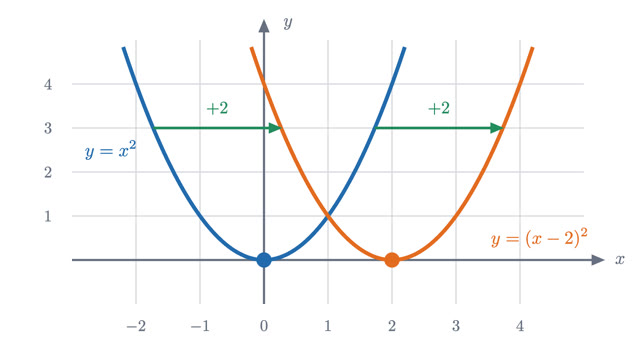
Shifting and stretching graphs: why f(x - 2) moves rightAdding 2 outside a function lifts its graph, but subtracting 2 inside moves it right. A graph is a set of points, and tracking one point explains why.
-
2
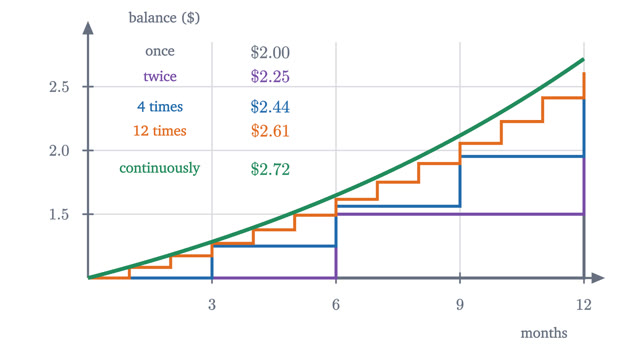
Compound interest and where e comes fromPay 100% interest in more and more instalments and a dollar grows to 2, 2.25, 2.44, 2.61, and then stops short of 2.72. That ceiling is the number e.
-
3
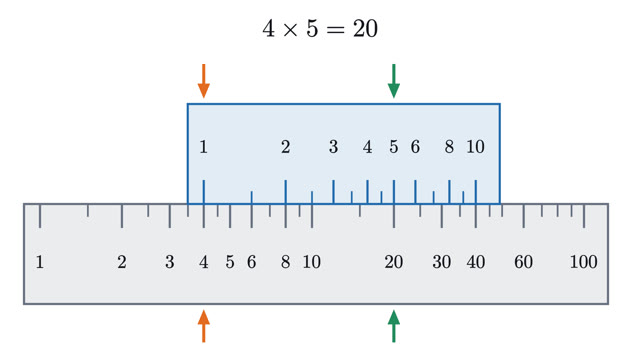
What a logarithm is: turning multiplication into additionA logarithm answers "what exponent gives this number?". Because exponents add when powers multiply, logarithms turn every product into a sum.
-
4
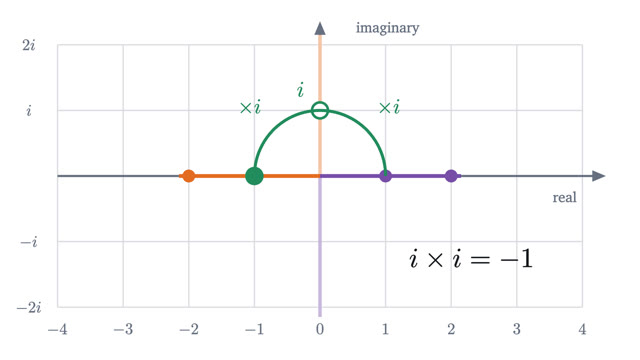
Complex numbers: why multiplying by i is a quarter turnNo number on the line squares to -1. Read multiplication by -1 as a half turn and the missing number appears: a quarter turn, which needs a second axis.
-
5
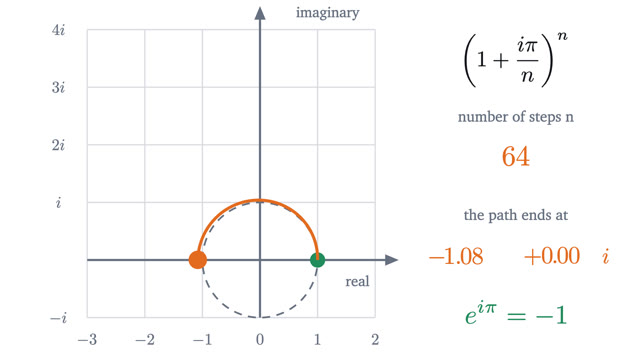
Euler's formula: why e^(iπ) = -1You cannot multiply e by itself iπ times, so the famous equation needs a definition first. Compound interest supplies one, and it leads around a circle.
-
6
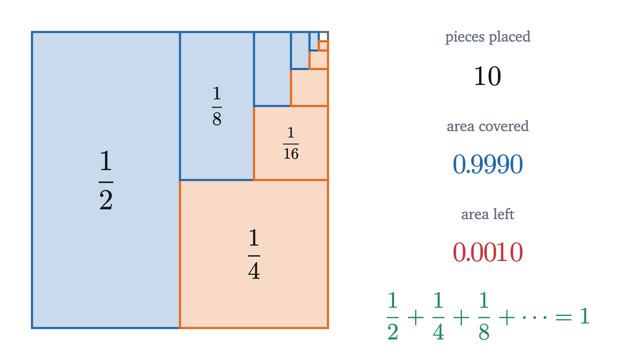
Geometric series, and why 0.999... equals 1What it means to add infinitely many numbers, when a geometric series has a sum, the formula a/(1 - r) with proof, and why 0.999... is exactly 1.
-
7
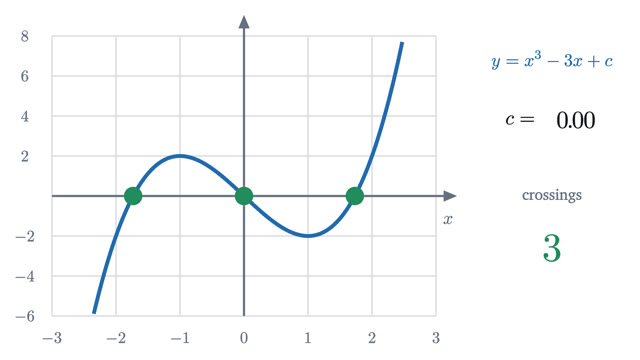
Roots, factors and the shape of a polynomialA cubic crosses the x axis once or three times, never exactly twice. The factor theorem, multiplicity and the leading term explain why, with proofs.