Eigenvectors Are Directions That Survive
A matrix is often introduced as a rectangle of numbers. That is useful for calculation, but it hides the main idea. A matrix is a function that takes vectors as input and returns vectors as output. In two dimensions, it moves every arrow in the plane to a new arrow.
Some matrices mostly stretch. Some rotate. Some shear, so squares become slanted parallelograms. The hard part is that all of these actions happen at once. If you watch one random arrow, it may both turn and change length, and from that single arrow it is hard to tell what the matrix is really doing.
Eigenvectors are the arrows that simplify the story. They are the directions that do not turn. A matrix may stretch them, shrink them, or flip them, but it leaves the line they lie on intact.
If $A$ is a matrix and $v$ is a nonzero vector, the eigenvector equation is
The number $\lambda$ is the eigenvalue. It says how much the direction is scaled. The vector $v$ says which direction survives.
live slideshowessay-2026-eigenvectors-are-directions-that-survive-1.mcs
param shear = 0.0
background = BLACK
camera = Camera(4b)
let Transform = |x, y, shear| [x + shear * y, y, 0]
let Grid = |shear| block {
for (i in range(-3, 4)) {
. stroke{GRAY, 0.8} Line(start: Transform(-3, i, shear), end: Transform(3, i, shear))
. stroke{GRAY, 0.8} Line(start: Transform(i, -2, shear), end: Transform(i, 2, shear))
}
}
let Arrow = |x, y, shear, color| block {
. stroke{color, 3} Line(start: [0, 0, 0], end: Transform(x, y, shear))
. fill{color} center{Transform(x, y, shear)} Circle(0.045)
}
let Diagram = |shear| block {
. Grid(shear)
. Arrow(1.6, 0, shear, GREEN)
. Arrow(1.0, 1.0, shear, ORANGE)
. color{WHITE} center{[0, -1.75, 0]} Text("the green direction survives the shear", 0.88)
}
mesh diagram = Diagram($shear)
"shear the plane"
shear = 1.25
play Lerp(1.5)In this shear, the horizontal direction is special. A horizontal arrow stays horizontal. It may move through a distorted grid, but the line it lives on is unchanged. The orange arrow does not have that luck: it is pushed into a new direction.
The eigenvector is not important because it is common. It is important because it gives a coordinate system in which the transformation becomes simple.
Watching a whole line
The equation $Av=\lambda v$ says something stronger than "one arrow goes to a parallel arrow." If $v$ is an eigenvector, then every vector on the same line is also sent to that same line:
So an eigenvector is really an eigenline. The matrix has discovered a one-dimensional world inside the plane and acts on that world by ordinary multiplication.
This is why eigenvectors show up whenever a process repeats. If applying $A$ once multiplies a direction by $\lambda$, then applying it $n$ times multiplies that direction by $\lambda^n$:
For a random vector, repeated multiplication may be hard to predict. For an eigenvector, it is just a power.
Decomposing a vector into surviving directions
The best case happens when a matrix has enough eigenvectors to form a basis. Then any vector can be written as a mixture of those special directions:
Applying the matrix gives
The matrix no longer feels like a mysterious two-dimensional action. It becomes two independent one-dimensional scalings.
That is the geometric content of diagonalization. A diagonal matrix is not merely a convenient format. It is a matrix written in coordinates that agree with its natural directions.
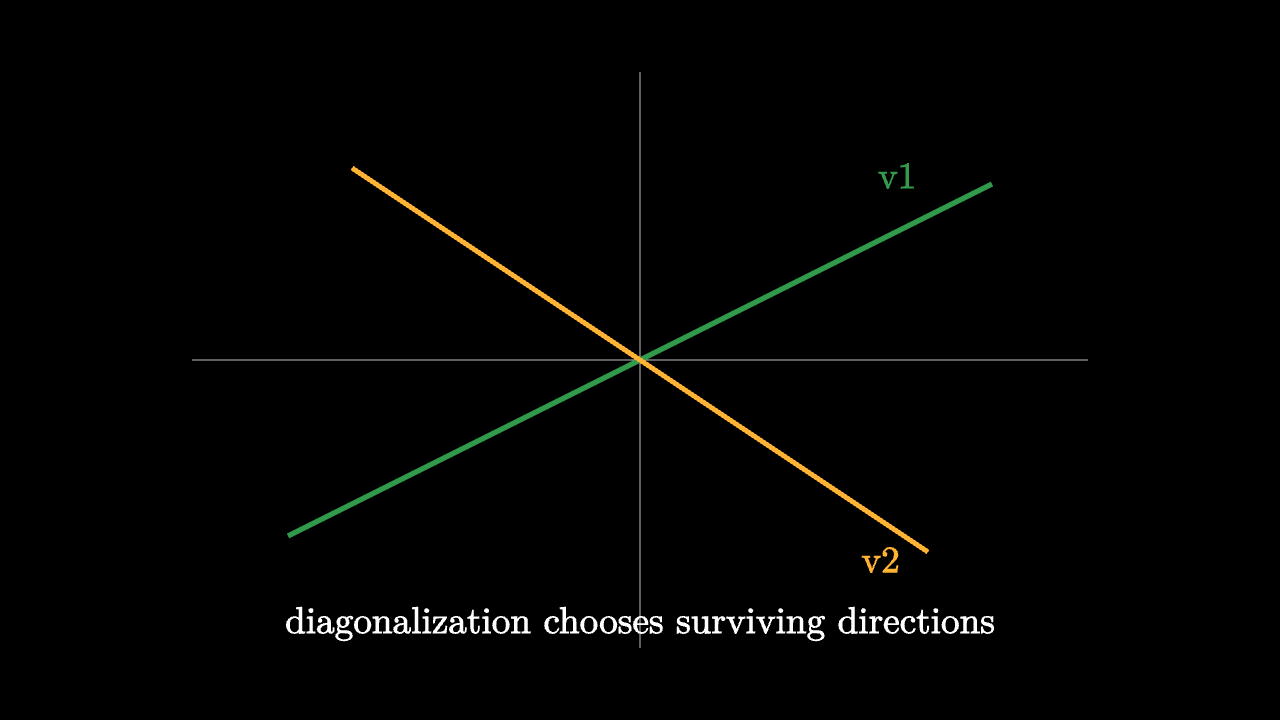
imageessay-2026-eigenvectors-are-directions-that-survive-2.mcs
background = BLACK
camera = Camera(4b)
mesh diagram = block {
. stroke{GRAY, 1} Line(start: [-2.8, 0, 0], end: [2.8, 0, 0])
. stroke{GRAY, 1} Line(start: [0, -1.8, 0], end: [0, 1.8, 0])
. stroke{GREEN, 3} Line(start: [-2.2, -1.1, 0], end: [2.2, 1.1, 0])
. stroke{ORANGE, 3} Line(start: [-1.8, 1.2, 0], end: [1.8, -1.2, 0])
. color{GREEN} center{[1.6, 1.15, 0]} Text("v1", 0.84)
. color{ORANGE} center{[1.5, -1.25, 0]} Text("v2", 0.84)
. color{WHITE} center{[0, -1.65, 0]} Text("diagonalization chooses surviving directions", 0.84)
}
"eigenbasis"
play Fade(0.6)When there are no real directions
Not every matrix has real eigenvectors. A pure rotation by $90^\circ$ turns every nonzero vector. No real direction survives. Algebraically, its eigenvalues are imaginary. Geometrically, that is exactly what you should expect: the plane has no line that a quarter-turn leaves on itself.
This failure is not a nuisance. It tells you what kind of motion you are looking at. A real eigenvector means the matrix has a real invariant line. Complex eigenvalues mean the action is partly rotational. Repeated powers then produce cycles or spirals rather than simple growth along fixed lines.
The real reason they matter
Eigenvectors are not a trick for solving homework problems. They are the stable directions of a transformation. They identify the axes along which a complicated operation becomes multiplication.
That is why the same idea appears in differential equations, quantum mechanics, graph ranking, Markov chains, vibration modes, and principal components. Each setting has a process that transforms a state. Eigenvectors are the states whose identity survives that transformation.
The slogan is short, but it is worth taking literally: